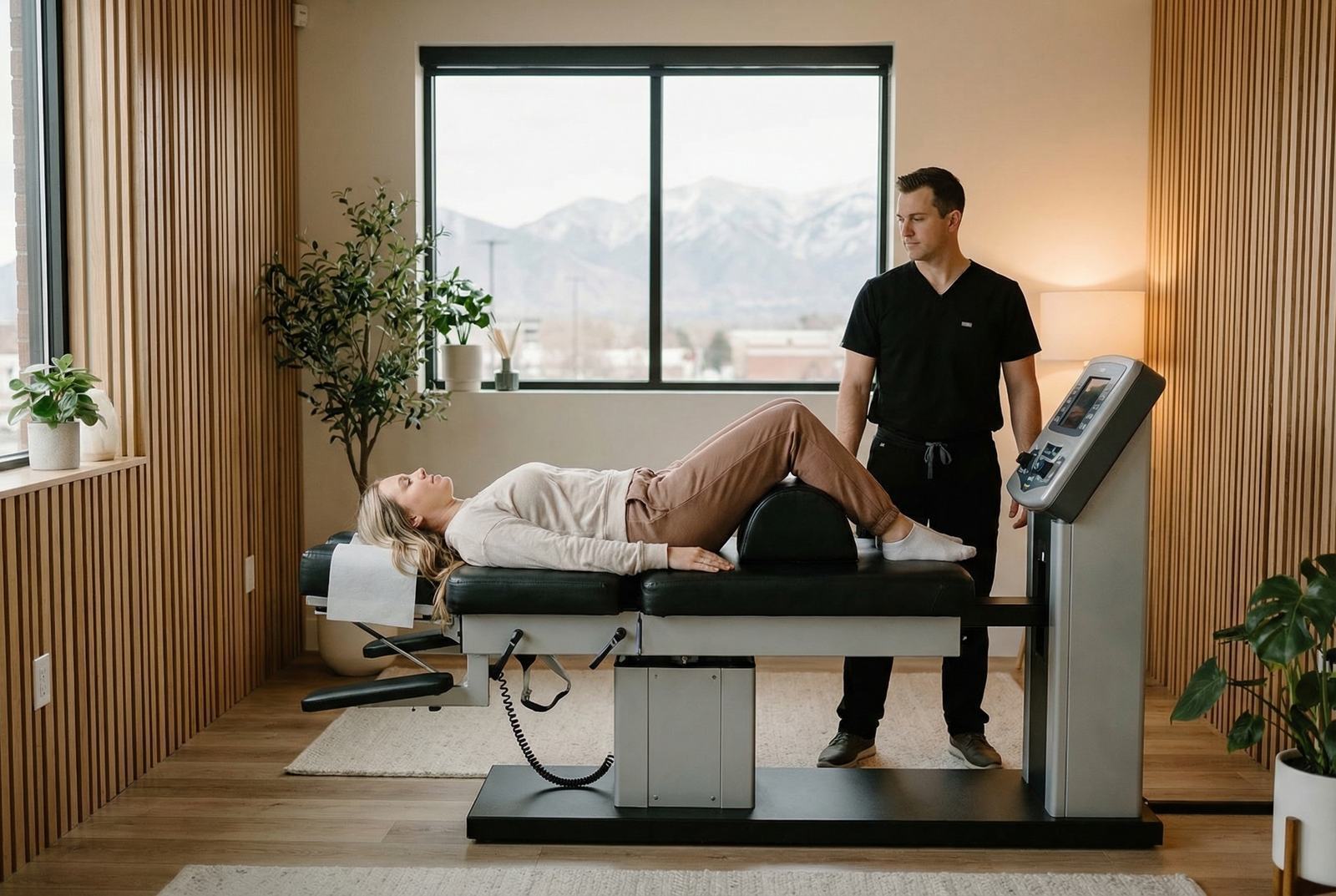
Spinal Decompression Therapy in Murray, UT
Non-surgical decompression care for disc irritation, sciatica, and compression-sensitive back pain
Non-surgical decompression care for disc irritation, sciatica, and compression-sensitive back pain
Some back pain improves with a few days of lower activity. Other cases keep returning whenever you sit, bend, drive, or try to get back to exercise. When symptoms behave like a disc problem or nerve compression pattern, spinal decompression therapy may be part of the answer.
Spinal decompression is designed to create a gentler loading environment for irritated discs and surrounding structures. At Mecham Chiropractic, decompression is used as part of a broader plan that may also include back pain care, sciatica treatment, joint treatment, and movement guidance based on how your symptoms behave.
Spinal decompression therapy is a non-surgical treatment that applies controlled traction to reduce pressure through the spine. It is commonly considered when symptoms look disc-related, nerve-related, or strongly compression-sensitive.
Decompression tends to make the most sense when the symptom pattern suggests the disc and nerve mechanics need unloading. It is not a universal answer for every back pain case. The better the exam matches the disc-driven pattern, the more useful decompression usually becomes.
Spinal decompression can be helpful for a herniated disc when symptoms are made worse by compression, sitting, bending, or nerve irritation and the exam supports a disc-driven mechanical problem.
Patients usually start exploring decompression when they are tired of recurring disc flare-ups, driving pain, prolonged sitting pain, or leg referral that keeps interrupting work and daily life. Many want a conservative option before considering more invasive interventions.
We deliver decompression on the DRX9000, a computer-controlled decompression table made by Excite Medical. It is an FDA-cleared medical device, cleared for chronic low back pain and sciatica associated with herniated discs, degenerative disc disease, and posterior facet syndrome.
What sets a purpose-built decompression table apart from simple lumbar traction is control. Basic traction pulls; decompression applies a computer-regulated distraction curve that ramps tension up and down through each cycle. That matters because pulling too hard or too abruptly triggers a protective muscle response — the body guards, the muscles tighten, and the force never reaches the disc. A graded curve is designed to stay under that guarding threshold so the distraction actually reaches the target segment.
The mechanical intent is to reduce compressive load on the involved disc and the nerve root exiting at that level. Reducing pressure inside the disc is thought to support fluid and nutrient exchange in a structure that has very little blood supply of its own, which is part of why disc problems can be slow to settle. Response varies from patient to patient, and decompression is not appropriate for every case — the exam comes first.
Most decompression cases we see are lumbar — the low back. Lumbar decompression targets the L1 through L5 segments and the L5–S1 junction, which carry the most load and account for the majority of disc bulges, herniations, and the leg symptoms that come with them. When patients search for lumbar traction or low back decompression, this is the care they are describing.
The mechanical goal is specific: reduce compressive load on the involved lumbar segment so the disc and the nerve root leaving that level are under less pressure. Positioning is set to the level identified during your exam, because decompression aimed at the wrong segment does not accomplish much.
Lumbar cases commonly present as one of these patterns:
Decompression is not automatically the answer for any of these. The exam determines whether the problem is genuinely disc-driven and compression-sensitive, which is what decompression is designed to address. If your presentation points elsewhere, back pain treatment or a bulging disc evaluation may be the more appropriate starting point.
Our Murray office is convenient for patients from Holladay, Millcreek, South Salt Lake, Cottonwood Heights, and nearby areas looking for spinal decompression therapy with a clear chiropractic exam guiding the decision. If you're searching for a chiropractor near you in Murray or anywhere in the Salt Lake Valley, our office is conveniently located and easy to reach from most neighborhoods.
To learn more about how conservative care addresses disc injuries, read our guide: Chiropractic for Bulging or Herniated Disc. For a deeper look at which lumbar levels are treated and why a regulated pull curve matters, see Lumbar Decompression Explained.
Book a Decompression EvaluationThis page supports patient education and local service discovery. It is reviewed against the site's editorial policy, connects to Dr. Cody Mecham's background and certifications, and is paired with supporting content on the blog and education hub.
Spinal decompression therapy is a non-surgical treatment that uses controlled traction to reduce pressure through the spine, especially in disc-related and nerve-related cases.
Yes. Spinal decompression may help sciatica when leg symptoms are tied to disc pressure or a compression-sensitive lumbar pattern.
No. Spinal decompression therapy in this context is a conservative, non-surgical treatment used before considering more invasive options.
Good candidates often have herniated disc symptoms, recurring sciatica, or compression-sensitive back pain, but the exam determines whether decompression is the right fit.
Disc-related pain often worsens with sitting, bending, driving, or nerve referral, but the best way to know is through a targeted exam rather than guessing from symptoms alone.
It can. Spinal decompression is often considered when bulging-disc symptoms behave like a compression-sensitive or disc-driven pattern.
It is usually designed to feel gentle and controlled rather than painful, with settings adjusted to the patient and symptom pattern.
Yes. Decompression is often part of a broader plan that may also include adjustments, soft tissue work, and movement guidance.
No. Decompression is best used when the exam suggests a disc-related or compression-sensitive mechanical problem.
It is worth asking about when disc flare-ups, sitting pain, nerve referral, or recurring compression-sensitive back pain keep coming back.
Lumbar decompression is spinal decompression applied to the low back, targeting the L1 through L5 segments and the L5–S1 junction. These levels carry the most load and account for the majority of disc bulges, herniations, and the leg symptoms that come with them. It is the most common form of decompression care we provide.
No. Lumbar decompression surgery is an operation such as a laminectomy or microdiscectomy that removes tissue pressing on a nerve. Non-surgical lumbar decompression is a mechanical, non-invasive therapy that reduces compressive load on the disc and nerve root without incisions, anesthesia, or recovery downtime.
Most commonly L4–L5 and L5–S1, the two lowest lumbar segments, because they bear the greatest load and are the most frequent sites of disc injury. Positioning is set to the specific level identified during your exam, since decompression aimed at the wrong segment accomplishes little.
The DRX9000 is a computer-controlled spinal decompression table made by Excite Medical. It is an FDA-cleared medical device, cleared for chronic low back pain and sciatica associated with herniated discs, degenerative disc disease, and posterior facet syndrome. It is the system we use for decompression care at our Murray office.
Basic traction applies a steady pull. The DRX9000 applies a computer-regulated distraction curve that ramps tension up and down through each cycle. This matters because pulling too hard or too abruptly triggers a protective muscle guarding response, and once the muscles tighten the force never reaches the disc. A graded curve is designed to stay below that guarding threshold.
Herniated disc, bulging disc, degenerative disc disease, posterior facet syndrome, sciatica from a compressive lumbar source, and chronic low back pain that worsens with sitting, driving, or bending. Decompression is not appropriate for every case, so an exam determines whether the problem is genuinely disc-driven and compression-sensitive.