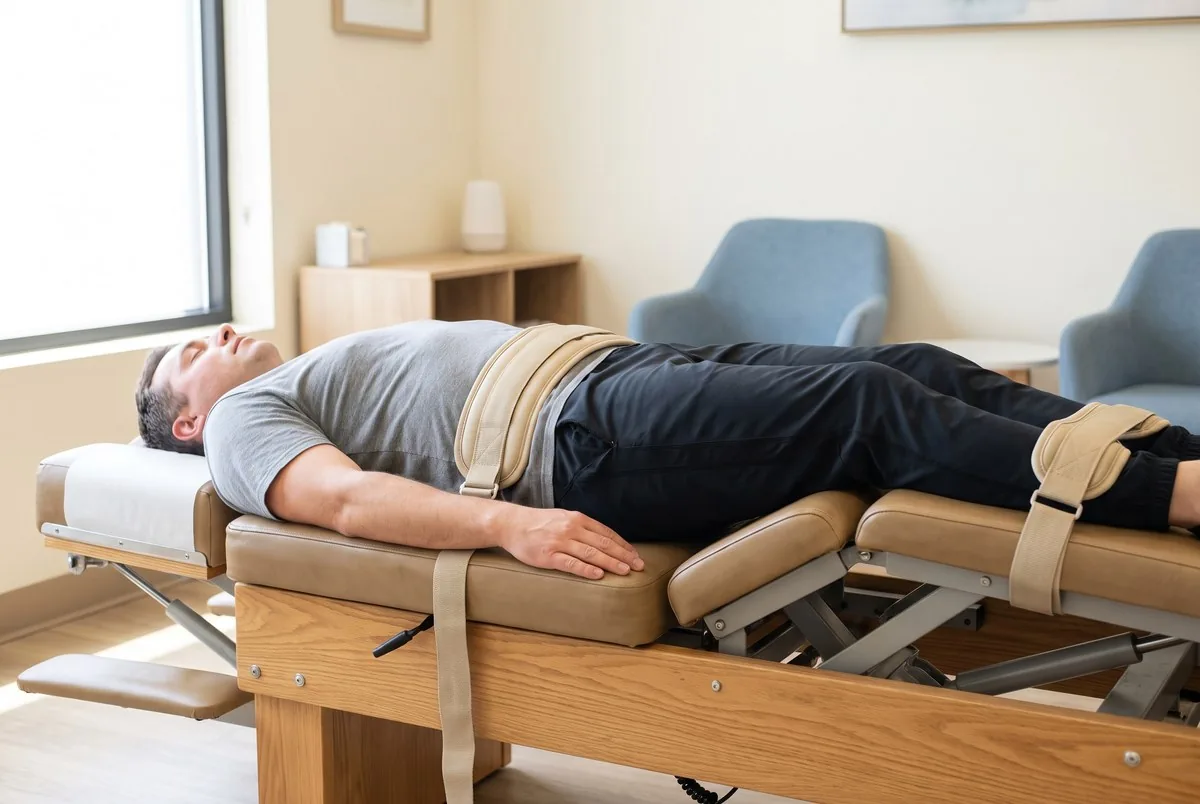
Lumbar decompression applies a controlled, cycling pull along the spine to reduce pressure on a targeted disc and on the nerve root leaving at that level. Most cases target L4–L5 and L5–S1, the two lowest segments, which carry the most load and are the most common sites of disc bulges and herniations.
- How the table pulls matters more than how hard it pulls
- Steady traction triggers a muscle guarding reflex that absorbs the force before it reaches the disc
- Motorized decompression cycles the pull so the muscles do not brace against it
- An L5–S1 problem is often felt in the buttock, back of the thigh, or calf rather than the back
- Facet joint, sacroiliac, and muscular low back pain are not disc-driven and need a different tool
- Screened out first: spinal fracture, fusion hardware, active spinal cancer, osteoporosis below a safe threshold, pregnancy, aortic aneurysm
When people search for lumbar decompression, they are almost always describing the same situation: low back pain that has stopped responding to rest, often with something travelling down a leg. This guide covers the part most explanations skip — which spinal levels are actually being treated, and why the way a table pulls matters more than how hard it pulls.
Why "Lumbar" Is Almost Always the Answer
The lumbar spine is the five-segment stretch of low back running from L1 down to L5, where it meets the sacrum at the L5–S1 junction. Those bottom two levels — L4–L5 and L5–S1 — sit at the base of the column and carry the load of everything above them. Every time someone bends, lifts, or settles into a car seat, those two segments absorb a disproportionate share of it.
That is why they are also the most common sites of disc bulges and herniations, and why the overwhelming majority of decompression cases are lumbar cases. When a disc at L5–S1 loses height or pushes beyond its normal border, the nerve root exiting at that level is right there. The result is often felt nowhere near the back — it shows up in the buttock, the back of the thigh, the calf.
What Decompression Is Actually Doing
A decompression table applies controlled axial distraction: a measured pull along the length of the spine, with the patient positioned so the force concentrates at a targeted segment. The mechanical intent is to reduce compressive load on that disc and on the nerve root leaving at that level.
There is a second reason pressure matters. Spinal discs have very little blood supply of their own and depend heavily on load and unload cycles to move fluid and nutrients in and out. A segment stuck under more or less constant compression is a poor environment for that exchange, which is part of why disc problems can be slow to settle even when someone is doing everything right. Reducing pressure is intended to improve those conditions.
Worth being straight about: response varies from person to person, and decompression is not the right answer for every back. What it addresses is a specific mechanical problem — a compression-sensitive, disc-driven one.
Lumbar Decompression vs. Basic Traction
This is the distinction that matters most, and it is the one patients almost never hear explained.
Basic lumbar traction applies a steady, sustained pull. The problem is that the body objects. When spinal muscles sense a constant tug, they contract to resist it — a protective guarding reflex. Once those muscles tighten, they absorb the force, and very little of it reaches the disc that was the entire point. Pulling harder makes the guarding worse, not better.
Purpose-built decompression works around that reflex rather than fighting it. Instead of a constant pull, it applies a computer-regulated distraction curve: tension ramps up, holds, eases back, and repeats in cycles. Staying below the threshold that triggers guarding is what allows the distraction to actually reach the targeted segment.
At our Murray office we deliver decompression on the DRX9000, a computer-controlled decompression table made by Excite Medical. It is an FDA-cleared medical device, cleared for chronic low back pain and sciatica associated with herniated discs, degenerative disc disease, and posterior facet syndrome.
Lumbar Patterns That Point Toward Disc Involvement
No symptom by itself proves a disc is responsible, but these patterns come up repeatedly in cases that turn out to be disc-driven:
- Worse with sitting or driving. Sitting loads the lumbar discs more than standing does. Pain that peaks on a commute and eases when walking is a classic loading pattern.
- Pain travelling below the knee. Referral following a nerve root path — buttock to thigh to calf — suggests the nerve root is involved, not just local muscle. This overlaps heavily with sciatica.
- Hard to bend forward or stand up from a chair. Flexion reloads the disc, so flexion-sensitive presentations often point to it.
- Flare-ups that settle, then return. A cycle of resolution and recurrence usually means the underlying mechanical problem was never fully addressed.
- Morning stiffness that eases with movement, then worsens by evening. A loading-tolerance pattern consistent with a segment that fatigues under accumulated compression.
When Decompression Is Not the Right Tool
Screening happens before any decompression begins. Contraindications include spinal fracture, spinal fusion hardware, active cancer affecting the spine, osteoporosis below a safe threshold, pregnancy, and aortic aneurysm.
Beyond outright contraindications, plenty of low back pain simply is not disc-driven. Facet joint irritation, sacroiliac dysfunction, and muscular pain all produce low back pain that decompression is not designed to address. That is why the exam comes first rather than the table. If your presentation points elsewhere, back pain treatment or chiropractic adjustments may be the better starting point.
How It Fits With the Rest of Care
Decompression is rarely used alone. Reducing pressure on a disc addresses one part of the problem; the joints above and below still need to move properly, and the surrounding muscles are usually carrying compensation patterns of their own. Care typically combines decompression with adjustment of the involved region and guidance on positions and movements that keep reloading the irritated tissue between visits.
For details on session structure, how many visits a typical plan involves, and how candidacy is assessed, see our companion guide: Is Spinal Decompression Right for You? Full service details are on our spinal decompression page.
Getting Evaluated in Murray, UT
If the patterns above sound familiar, the useful next step is an examination that determines whether a lumbar disc is genuinely driving the problem. Mecham Chiropractic serves patients from Murray, Millcreek, Holladay, Sugar House, Cottonwood Heights, South Salt Lake, and Midvale.
Book a Decompression Evaluation