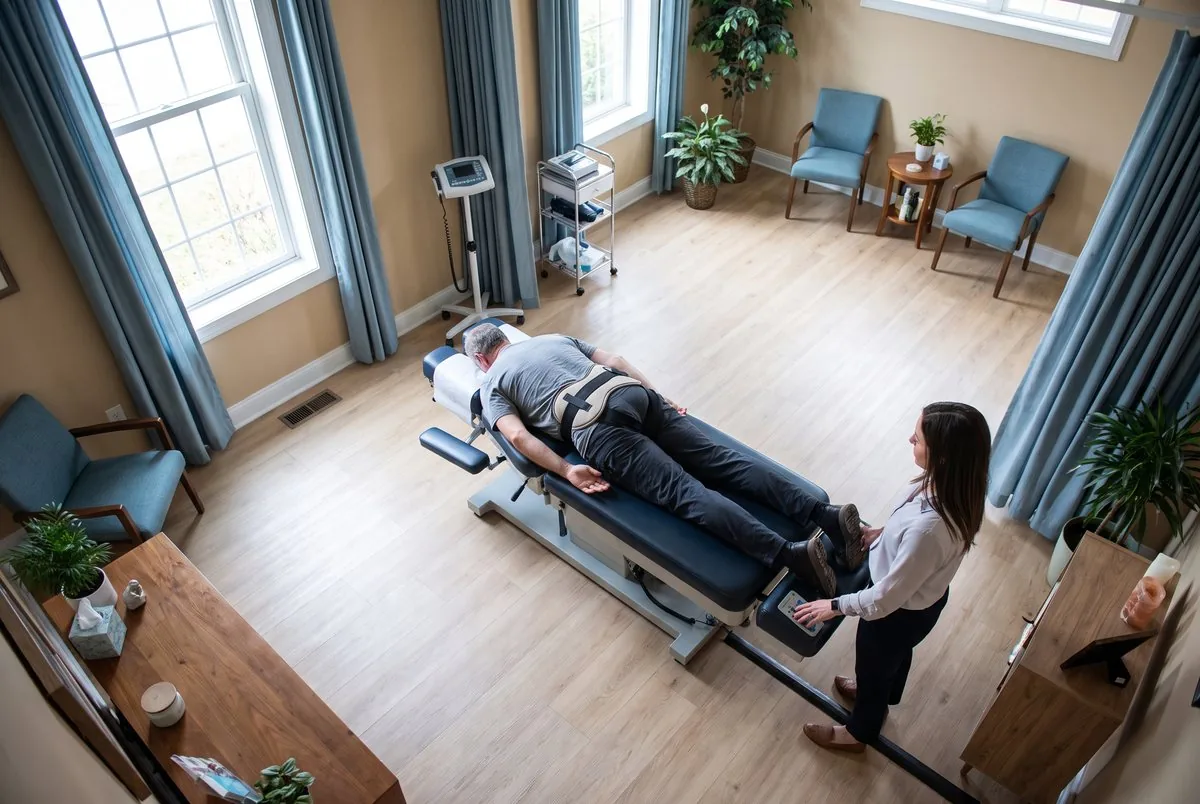
Non-surgical spinal decompression uses a computer-controlled traction table to gently stretch the spine in cycles, creating negative pressure inside the disc so bulging material can retract. It is a good fit when disc pressure is the main driver of the pain — herniation, degenerative disc disease, or disc-driven sciatica — and it is not the same as a chiropractic adjustment.
- A standard plan is 12 to 20 sessions over 4 to 6 weeks
- If there is no meaningful improvement within the first 4 to 6 sessions, the plan should be reconsidered
- It is a targeted plan with milestones, not open-ended maintenance care
- Not suitable with spinal fracture or instability, fusion hardware, active spinal cancer, osteoporosis below a safe threshold, or pregnancy
Non-surgical spinal decompression is one of the more misunderstood treatments in chiropractic care. Some patients have heard the term but are not sure what it actually involves, who it helps, or whether it is meaningfully different from a standard adjustment. This guide answers those questions directly, based on how decompression is used at Mecham Chiropractic in Murray, UT.
What Is Non-Surgical Spinal Decompression?
Non-surgical spinal decompression uses a motorized traction table to gently stretch the spine in a controlled, alternating pattern. The goal is to create negative pressure inside the disc — reducing the intradiscal pressure enough to allow bulging or herniated material to retract and to promote the flow of nutrients and hydration into a dehydrated or damaged disc.
It differs from simple manual traction in that the distraction force is precisely controlled by computer, delivered in cycles, and adjusted to avoid triggering muscle guarding. When the body senses a consistent sustained pull, muscles along the spine tighten to resist it — which defeats the purpose. Motorized decompression cycles in a way that reduces this response.
It also differs from chiropractic adjustment. An adjustment addresses joint restriction through a specific, controlled thrust or mobilization. Decompression addresses disc pressure and is typically used when disc involvement is a significant part of the clinical picture.
Conditions That Respond to Spinal Decompression
The strongest candidates for decompression therapy are patients with conditions where disc pressure is a central driver:
- Herniated or bulging disc: Decompression is most commonly used for disc herniations in the lumbar (lower back) or cervical (neck) spine where the disc material is pressing on a nerve root.
- Degenerative disc disease: Discs lose height and hydration over time. Decompression may slow this process and reduce the pain associated with narrowed disc spaces.
- Disc-driven sciatica: When sciatic nerve pain originates from a disc herniation at L4-L5 or L5-S1, decompression can reduce the pressure on the affected nerve root.
- Posterior facet syndrome: When disc space narrowing causes the facet joints to bear more load than normal, decompression can reduce the pressure and associated facet pain.
- Failed conservative care for disc pain: Patients who have tried rest, physical therapy, or standard chiropractic without sufficient relief for disc-driven pain are often the best candidates.
Who Is Not a Good Candidate
Decompression is not appropriate for everyone. Standard contraindications include:
- Spinal fracture or instability — including acute compression fractures
- Spinal fusion with metal hardware (screws, rods, cages)
- Active cancer affecting the spine
- Osteoporosis below a safe structural threshold
- Pregnancy
- Aortic aneurysm
- Severe nerve involvement (cauda equina syndrome) requiring surgical evaluation
A thorough intake, orthopedic exam, and review of any relevant imaging is completed before a decompression plan begins. If you are not a good candidate, Dr. Mecham will say so clearly and explain what alternatives might be more appropriate.
What a Decompression Session Feels Like
The patient is positioned on the decompression table and a harness is fitted around the pelvis (for lumbar decompression) or a cervical cradle supports the head and neck (for cervical decompression). The table does the work — you relax.
Most patients feel a gentle pulling sensation, particularly in the first few sessions. As treatment progresses and the spine responds, many patients report that they fall asleep during the session. The session lasts approximately 20 to 30 minutes.
Mild soreness the day after early sessions is not uncommon, similar to the soreness of beginning a new exercise program. Significant pain during a session is a signal to stop and reassess — that should not happen with properly applied decompression.
How Many Sessions Are Typically Needed?
A standard decompression plan runs 12 to 20 sessions over 4 to 6 weeks. Progress is assessed within the first several sessions. Patients who are not showing meaningful improvement within the first 4 to 6 sessions are unlikely to benefit from continuing, and the plan should be reconsidered.
This is an important point: decompression is not open-ended maintenance care. It is a targeted treatment plan with specific outcome milestones. At Mecham Chiropractic, patients receive a clear plan at intake — including how many sessions are expected, what improvement should look like by what point, and what happens if those milestones are not met.
Decompression vs. Surgery: What Murray Patients Should Know
The comparison patients most often want to understand is decompression versus lumbar discectomy or cervical fusion. These are not equivalent options — they serve different levels of pathology.
Surgery is appropriate when there is progressive neurological loss (worsening weakness, bowel or bladder dysfunction, loss of reflexes) or when conservative care has comprehensively failed for a serious structural problem. Decompression is a conservative, non-invasive option best suited for patients who have not yet exhausted non-surgical options or who want to try everything appropriate before considering surgery.
Many patients who had been told they might need surgery have found adequate relief through decompression. Many others proceed to surgery when it becomes the clearly correct next step. The goal is to match the patient to the right intervention — not to sell any particular approach.
Can I do decompression and chiropractic adjustments at the same time?
Yes. Decompression and chiropractic care are often used together. Adjustments address joint restriction while decompression addresses disc pressure. The combination is more comprehensive than either alone for many disc-driven conditions.
Do I need an MRI before starting spinal decompression?
An MRI is helpful but not always required before starting. Dr. Mecham performs a clinical evaluation and may recommend imaging if the findings suggest a condition that needs to be confirmed or ruled out before treatment. For patients with prior imaging, bringing it to the first visit is always useful.
Is decompression covered by insurance?
Coverage varies by plan. Mecham Chiropractic does not accept health insurance but does accept HSA and FSA cards. Auto accident patients may be able to use PIP coverage for decompression as part of a post-collision treatment plan. Call the office for specific questions about coverage and payment options.
Sources
- Apfel CC, et al. Restoration of disc height through non-surgical spinal decompression is associated with decreased discogenic low back pain. J Neuroimaging. 2010. PMID 20663130
- Choi J, et al. Influences of spinal decompression therapy and general traction therapy on the pain, disability, and straight leg raising of patients with intervertebral disc herniation. J Phys Ther Sci. 2015. PMID 25843135